How to Efficiently Process Copper Ores with Complex Composition?
โรบิน
นักธรณีวิทยาทางเศรษฐกิจระดับสูงและนักวิเคราะห์แร่
Processing copper ores with complex composition requires a flexible, data‑driven approach. The key is to understand exactly what minerals are in the ore, how they liberate, and how impurities will affect downstream recovery and product quality. A practical way to proceed is to follow a structured decision sequence and tailor the flowsheet to separate the oxide and sulfide portions, while managing deleterious elements.
1) Thorough characterization is the foundation
- Mineralogy: identify copper-bearing minerals (chalcopyrite, bornite, chalcocite, malachite, cuprite, enargite, tennantite, covellite, etc.), gangue minerals, and clay/organic constituents that affect processing.
- Chemical analysis: determine Cu grade and mass balance of key impurities (Fe, S, Al2O3, SiO2, As, Sb, Pb, Zn, Hg, Se, Ag, Au).
- Liberation and texture: particle size distribution, liberation size of copper minerals, degree of fine-grained dissemination, presence of refractory minerals.
- Physical properties: hardness, agglomeration tendency, slimes potential, oxidation state distribution (oxide vs sulfide content).
- Process-suitability indicators: potential penalties in concentrate (As, Sb, Pb, Zn), cyanide/roasting considerations, and water/energy requirements.
2) Define a versatile flowsheet strategy
- If the ore has oxide-rich zones, sulfide-rich zones, and deleterious elements:
- Split the ore into oxide and sulfide streams as early as practical.
- Oxide stream: treat with hydrometallurgical methods (preferably SX-EW) to produce copper cathodes; useful for low-impurity oxide material.
- Sulfide stream: treat with flotation to produce a copper concentrate, then smelt/refine to refined copper (or use alternative processing if the concentrate has atypical impurities).
- If the ore is predominantly sulfide but also contains oxide phases:
- Flotation to produce copper sulfide concentrate while simultaneously leaching or recovering oxide portions via SX-EW or heap/vat leaching if feasible.
- For complex, impurity-rich ores (As, Sb, Zn, Pb, Cd, etc.):
- Consider ore blending with cleaner material to dilute penalties.
- Plan for impurity management in the concentrate (e.g., limit As-bearing concentrates, or detour with detoxification steps).
- Explore pre-treatment steps to remove or stabilize problematic minerals (selective flotation depressants/activators, partial roasting, or bioleaching of specific fractions if economical).
- For fine-grained or refractory copper minerals:
- Incorporate regrinding of concentrates and cleaner flotation stages to improve copper recovery and concentrate grade.
- Assess alternative routes such as bioleaching/pressure oxidation for refractory components, if scale and cost justify.
3) Flotation optimization for complex ore
- Liberation control: grind to the liberation size of copper minerals without overgrinding gangue; use staged grinding/classification to minimize energy while achieving required liberation.
- Circuit design: roughing → scavenging → cleaning stages; multiple clean concentrates may be blended to meet market/spec requirements.
- Reagent package:
- Collectors: tailor to dominant copper minerals (xanthates, dithiophosphates, or specialty collectors for fine/refractory minerals).
- Frothers: choose for desired bubble stability and froth handling.
- Activators/depressants: use copper sulfate or other activators to improve chalcopyrite recovery; depress pyrite and other sulfides when they would degrade concentrate quality.
- pH modifiers: lime or ammonia systems to control flotation selectivity and surface chemistry.
- Managing deleterious minerals: implement depressants for iron sulfides or clays; consider upgrading the ore preparation to reduce slime formation.
4) Oxide ore processing options
- Hydrometallurgy (preferred for high-oxide copper content):
- Acid leach (usually sulfuric acid) in well-posed reactors or heaps/paddles.
- Leach conditions: temperature, residence time, and oxygen supply to optimize copper dissolution; manage ferric iron as a catalyst/oxidant.
- Solvent extraction-electrowinning (SX-EW) to produce copper cathodes.
- Impurity management: arsenic-bearing oxides may require special leach conditions or pre-treatment; monitor solution purity to minimize SX‑EW penalties.
- Heap or vat leaching is common for low-grade oxide ores; design for containment, drainage, and solution recovery efficiency.
5) Mixed oxide-sulfide ores: integrated flow
- A common efficient approach is to route oxide portions to SX-EW and sulfide portions to flotation/concentrate production.
- The final metal output is the sum of cathodes from SX-EW and refined copper from smelting/refining of the sulfide concentrate.
- Use mass balance models to optimize split ratios, capex, and opex.
6) Handling impurities and environmental/societal factors
- Impurity penalties: quantify how As, Sb, Pb, Zn, Hg, and other elements affect concentrate price and refinery penalties; design to minimize these in concentrates.
- Waste and water: maximize water reuse, minimize tailings generation (consider thickening and dry stacking where feasible).
- Energy: use energy-efficient grinding (high-pressure grinding rolls or vertical mills where appropriate), optimize grinding circuit to reduce circulating loads and over-grinding.
- Environmental controls: dust suppression, acid mine drainage prevention, and treatment of effluents.
7) Pilot testing and data-backed design
- Bench tests: locked-cycle flotation tests, mineralogical analyses, and liberation studies; flotation optimization for the specific ore.
- Leach tests: oxide ore leach kinetics, solution composition, and SX-EW compatibility.
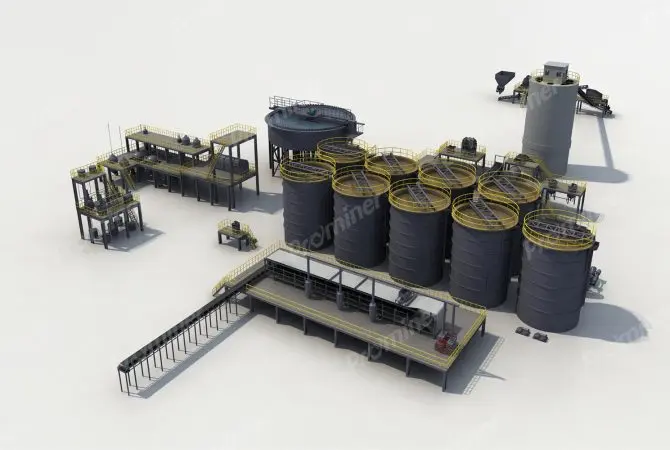
- Pilot plant: validate the integrated flowsheet (oxide and sulfide streams if applicable) before full-scale build.
- Modeling: mass balances, process simulations, and economic sensitivity analyses to compare alternative flowsheets and impurity handling strategies.
8) Practical blueprint for a typical complex ore
- If the ore has significant oxide copper and sulfide copper with impurities:
- Route oxide ore to SX-EW for copper cathodes.
- Route sulfide ore to flotation to produce a copper concentrate; if impurity levels are high, perform cleaning stages and, if needed, concentrate treatment (roasting or leaching of specific deleterious minerals) to meet refinery requirements.
- Use a blending strategy to ensure concentrate impurities stay within refinery penalties or to minimize reprocessing costs.
- Consider optional pre-treatment steps for refractory or highly fine-grained copper minerals to boost overall copper recovery.
9) Common pitfalls to avoid
- Over-grinding of oxide material or over-reliance on one route (e.g., only flotation for mixed oxide/sulfide ores) without validating impurity handling.
- Underestimating the water/energy balance for large-scale oxide leaching and SX-EW operations.
- Not validating the ore with a pilot plant or insufficient bench testing for the oxide/sulfide split and impurity scenarios.
- Failing to incorporate ore variability into the design (seasonal or head-grade fluctuations).
Bottom lineEfficient processing of copper ores with complex composition hinges on:
- Early, accurate characterization and liberation analysis.
- A flexible flowsheet that separates oxide and sulfide fractions and manages impurities.
- Optimized flotation with a tailored reagent scheme and energy-conscious grinding.
- Hydrometallurgical options (SX-EW) for oxide-rich portions and conventional flotation + smelting for sulfide-rich portions.
- Pilot testing and robust economic modeling to select the best combination and to handle ore variability.
คำถามที่พบบ่อย
ลักษณะของแร่มีความแตกต่างกันอย่างมากแม้ในแร่ก้อนเดียวกัน การทดสอบจากผู้เชี่ยวชาญ (เช่น การวิเคราะห์ทางเคมี, XRD และ SEM) จะช่วยให้แน่ใจว่าแผนภาพการไหลได้รับการปรับให้เหมาะสมสำหรับเกรดแร่และขนาดการปล่อยที่เฉพาะเจาะจงของคุณ ซึ่งจะป้องกันการไม่ตรงกันของอุปกรณ์ที่อาจมีค่าใช้จ่ายสูงและรับประกันอัตราการฟื้นฟูที่สูงที่สุดเท่าที่จะเป็นไปได้สำหรับโครงการของคุณ
A: เรามีสต็อกชิ้นส่วนสึกหรอหลักอย่างถาวร (เช่น แผ่นโม่หิน, ตาข่ายกรอง, และสื่อบด) สำหรับลูกค้าระหว่างประเทศ เราจัดทำ "รายการอะไหล่แนะนำ 2 ปี" พร้อมกับการสั่งซื้อครั้งแรก การสนับสนุนทางเทคนิคมีให้บริการตลอด 24 ชั่วโมงผ่านวิดีโอรีโมต และสามารถจัดการเยี่ยมชมสถานที่สำหรับความต้องการการบำรุงรักษาที่ซับซ้อนได้
A: ใช่ เราส่งทีมวิศวกรเครื่องกลและไฟฟ้าระดับสูงไปยังสถานที่เพื่อดูแลการติดตั้ง การเริ่มต้นใช้งาน และการทดสอบโหลดของอุปกรณ์ นอกจากนี้เรายังมีการฝึกอบรมที่ครอบคลุมสำหรับผู้ปฏิบัติงานท้องถิ่นของคุณเพื่อให้แน่ใจว่าการดำเนินงานในระยะยาวเป็นไปอย่างราบรื่น
A: แน่นอน เราเชี่ยวชาญในการให้บริการ EPCM (วิศวกรรม, การจัดซื้อ, การจัดการก่อสร้าง) ซึ่งรวมถึงทุกอย่างตั้งแต่การทดสอบแร่เริ่มต้นและการออกแบบเหมืองไปจนถึงการผลิตอุปกรณ์, การขนส่ง, และการรวมโรงงานในขนาดเต็ม ทำให้มั่นใจได้ว่าจะมีการเปลี่ยนผ่านที่ไร้รอยต่อจากพื้นที่ก่อสร้างใหม่ไปสู่การผลิต