二次锂离子电池因其高开路电压、高能量密度、长寿命、无污染和小自放电等优点,被认为是最理想的储能和转换工具。目前,锂离子电池已广泛应用于便携式电子设备、电动汽车/混合动力汽车和储能系统等。随着智能化和多功能产品的需求,提升锂离子电池的能量密度已成为研究重点。在锂离子电池系统中,阳极和阴极材料在其能量密度中起着决定性作用。
目前,各种阳极和阳极材料及相应的电解液已在锂离子电池中开发和应用。商业电池中广泛使用的阴极材料是石墨,主要包括介相碳微球(MCMB)、人造石墨和天然石墨。由石墨制成的锂离子电池主要用于便携式电子产品。改性石墨已被用于动力电池和储能电池。市场上高端石墨产品的比容量接近理论值360mA•H•g−1,并且具有优良的循环性能,难以进一步提升。模拟结果表明,在1200mA•h•g−1范围内提升阴极材料的比容量仍能为提高电池的能量密度做出巨大贡献。
At present, the main problem in the preparation of Si/ graphite composites is how to ensure the uniform and stable composite of nano-Si and graphite, so that the composites can take into account both high specific capacity and cyclic stability. In general, the preparation of Si/ graphite composites with nano-Si and graphite as raw materials needs to be combined with a variety of technical means. In this paper, we only use the one-step technique of Si and graphite combination to classify, mainly including solid-phase mixing method, liquid phase process and vapor deposition process.
一、固相混合法
在早期,研究人员主要通过简单的机械混合,即固相混合法制备Si/石墨复合材料。尽管固相重组方法简单,但Si和石墨的结合并不紧密,大量Si暴露在电解液中,对电化学性能产生不利影响。
例如,Cheng等人使用高能机械球磨机将微米Si粉末、石墨粉末和多壁碳纳米管在不锈钢球磨罐中研磨,获得了含33wt% Si的纳米Si/石墨/多壁碳纳米管混合物。电化学测试表明,在35mA•g−1的电流密度下,首次可逆比容量约为2000mA•h•g−1,经过20个循环后可逆比容量保持在584mA•h•g−1。
Xu等人通过金属催化刻蚀制备了直径约为100nm的Si纳米线,然后直接将15wt%的Si纳米线与微米石墨粉末球磨以制备Si纳米线/石墨阳极材料。首次库仑效率为74%,经过15个循环后的可逆比容量为514mA•h•g−1。Yin通过机械球磨微米级Si粉末、Mn粉末和石墨获得了Si/Mn/石墨微米级复合材料,其中Si含量为20wt%。在电流密度为0.15mA•cm−2时,首次库仑效率为70%,经过20个循环后的可逆比容量为463mA•h•g−1。
Whittingham等人通过机械球磨Si粉末、铝粉和石墨获得了Si-Al-石墨复合材料,Si含量为7.9%。在0.5mA•cm−2电流密度下,首次可逆比容量为800mA•h•g−1,库仑效率为80%。经过10个循环后,可逆比容量保持在约700mA•h•g−1。
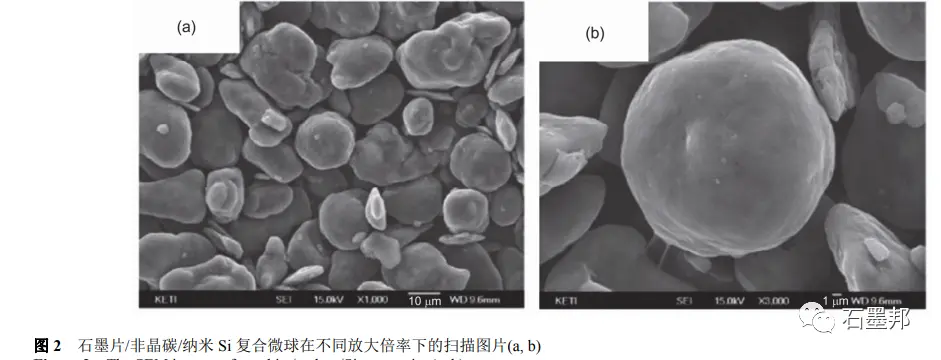
Kim等人通过球磨微米Si粉末制备了纳米Si粉末,然后与沥青和石墨片复合。经过机械造粒和高温煅烧,获得了纳米Si/无定形碳/石墨球形复合材料,Si含量约为20%。产品的结构如图2所示。电化学测试表明,在140mA•g−1的电流密度下,首次可逆比容量为560mA•h•g−1,首次库仑效率为86%,经过30个循环后可逆比容量保持在80%。第三相M(M为金属、石墨烯或无定形碳)的引入可以促进Si和石墨之间的紧密结合,有利于提高材料的电导率,为Si/石墨复合材料的制备提供了新的设计思路。
二、液相复合法
液相复合工艺可以使原材料在温和环境中更加均匀地分散,并通常引入第三相物质M(无定形碳、石墨烯、金属、金属硅化物等)促进Si与石墨的结合,这是Si/石墨复合材料制备的主要方向。
Guo et al. fully dispersed nano-Si, citric acid and flake graphite in ethanol solution. After drying, they calcined at 500℃ to obtain nano-Si/amorphous carbon/graphite composites, in which amorphous carbon tightly “bonded” nano-Si to the surface of graphite, and the mass fraction of Si was about 7.2%. Electrochemical tests show that the first coulomb efficiency is about 80% and the reversible specific capacity is 476mA•h•g−1 when the current density is 0.1A•g−1, and the specific capacity remains 86% after 100 cycles.
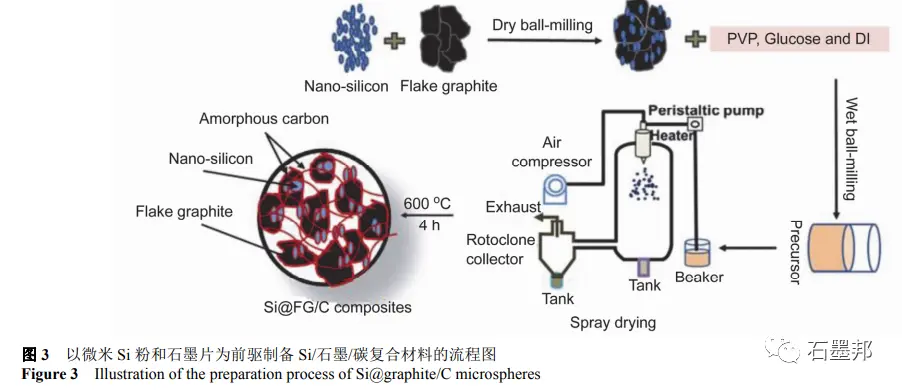
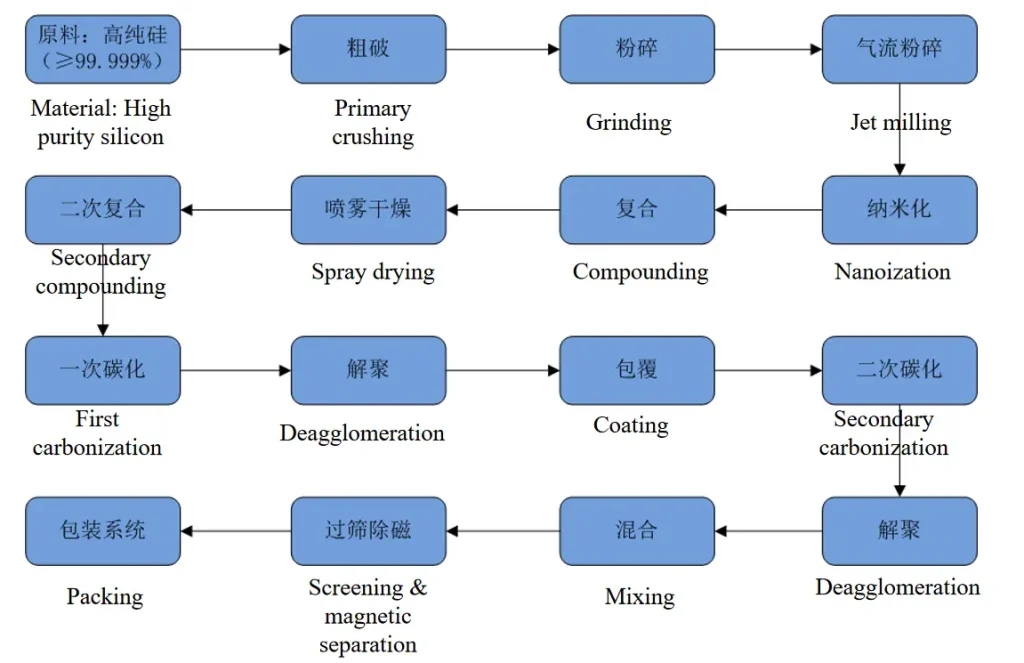
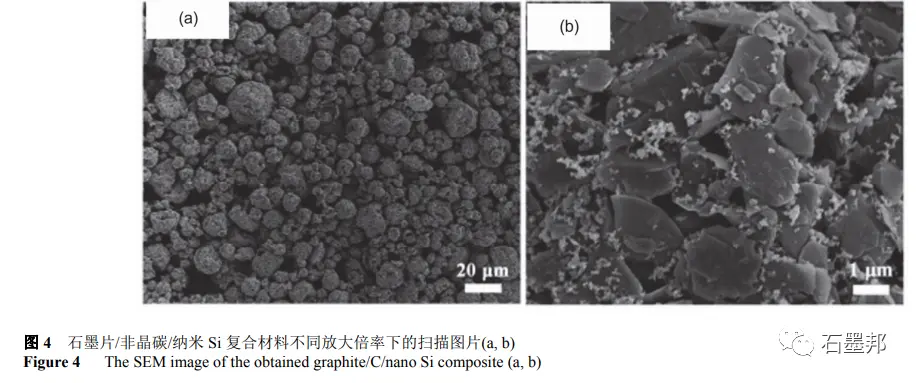
Cao et al. used commercial nano-Si powder and graphite sheet as raw materials, combined with mechanical ball milling, spray drying technology and high temperature calcination to obtain nano-Si/amorphous carbon/graphite composites, in which Si content is about 10%. Figure 3 shows a flow chart of the preparation process. The final samples obtained are micron particles composed of graphite sheets, Si nanoparticles and amorphous carbon, as shown in FIG. 4. Under the current density of 0.2A•g−1, the coulomb efficiency of the first ring is 74%, and the reversible specific capacity is 587mA•h•g−1. The reversible specific capacity is maintained at 420mA•h•g−1 for 300 cycles at A current density of 0.5A•g−1.
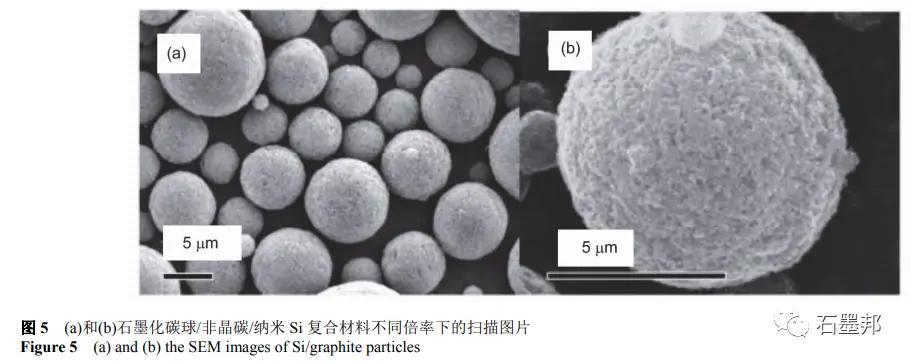
Su, such as using mechanical ball grinding micron size Si powder preparation of nanometer Si powder (100 nm), in water solution, the nano Si, glucose, graphitized carbon nano ball evenly dispersed, after spray drying granulation into micro ball precursor, after 900 ℃ calcination process in inert gas for Si/amorphous carbon/graphite composite materials, including Si content is 5 w t%. The resulting product is a micron sphere with multistage structure, as shown in Figure 5. Electrochemical measurements show that the reversible specific capacities are 435 and 380mA•h•g−1 at 500 and 1000mA•g−1, respectively. After 100 cycles of 50mA•g−1, the reversible specific capacity is 483mA•h•g−1, but the first coulomb efficiency is only 51%, mainly because nano-sized particles have large specific surfaces and form a large number of SEI films.
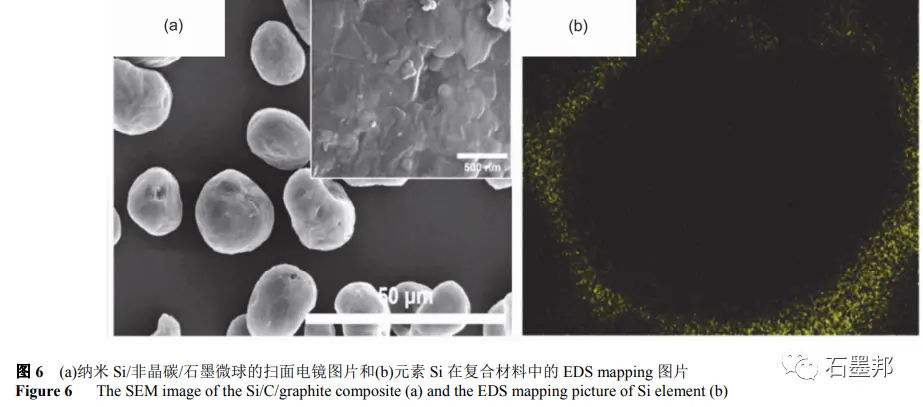
Kim et al. first dissolved coal pitch in tetrahydrofuran, and then added nano-Si powder and graphite microspheres. After ultrasonic dispersion, tetrahydrofuran is evaporated to obtain a precursor mixture, in which the ratio of Si to graphite can be controlled by adding raw materials. After calcination at 1000℃ in Ar atmosphere, amorphous carbon generated from asphalt pyrolysis “sticks” Si nanoparticles closely to the surface of graphite microspheres, as shown in FIG. 6. The final product is “potato shaped” particles, and Si nanoparticles are uniformly compound in the outer layer of graphite spheres.
当电流密度为0.15 A•g−1时,硅质量分数为15%的复合材料的首次可逆比容量和首次库仑效率分别为712 mA•h•g−1和85%。经过100个循环后,可逆比容量保持在80%。随着硅含量的增加,复合材料的比容量有所提高,但循环稳定性不是很高,主要由于硅的体积膨胀。
三、化学蒸气沉积
化学蒸气沉积主要是基于石墨。硅通过在高温下对硅烷的热解沉积在石墨表面。蒸气沉积最大的优势是硅纳米颗粒可以均匀分布在石墨表面。霍尔茨阿佩尔等人通过化学蒸气沉积直接在石墨片表面生长一层硅纳米颗粒(硅颗粒大小为10-20 nm,质量分数为7.1%)。电化学测试显示,首次可逆比容量为520 mA•h•g−1,库仑效率为75%,当电流密度为10 mA•g−1时,可逆比容量为470 mA•h•g−1。
Cho等人通过金属镍催化蚀刻石墨微球获得了多孔石墨,然后通过金属金催化裂解硅烷在多孔石墨上生长硅纳米线。获得了质量分数为20%的硅纳米线/石墨复合材料。图7显示了制备过程的仿真图。当电流密度为0.05c(1C = 1050mA•h•cm−2)时,第一循环的可逆比容量和库伦效率分别为1230mA•h•cm−2和91%。在0.2c下,经过100个循环的可逆比容量为1014mA•h•cm−2,未观察到明显衰减。
In summary, the composite process of Si nanocrystalline graphite mainly includes solid phase method, liquid phase method and gas phase deposition method, combined with spray drying, mechanical granulation, high temperature sintering and other technical means. In general, the introduction of a third phase material (amorphous carbon, graphene, metal, metal silicide) can further promote the uniform recombination of Si and graphite, so that the two are tightly “bonded” together, while forming a three-dimensional conductive network and avoiding direct contact between the nano Si and the electrolyte.
如需了解更多关于我们产品和解决方案的信息,请填写以下表格,我们的一位专家将尽快与您联系
Fax: (+86) 021-58779592
地址: 上海市浦东新区苗川路777号川沙商务中心D3栋二期606室
版权 © 2023. 与石(上海)矿业科技有限公司