When to Choose Single-Stage vs. Two-Stage Grinding Circuits?
Choosing between a single-stage or two-stage grinding circuit depends on the specific requirements of the ore material, throughput, product size, and energy considerations. Here’s a detailed guide to help determine the best choice:
単段粉砕回路
主な特徴:
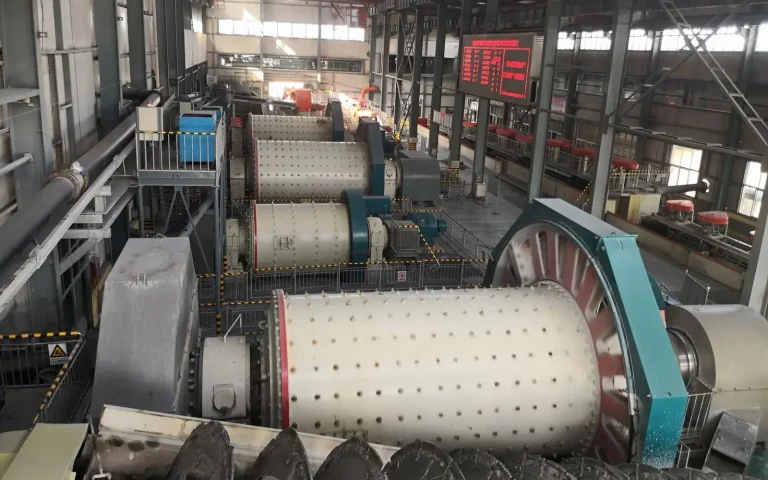
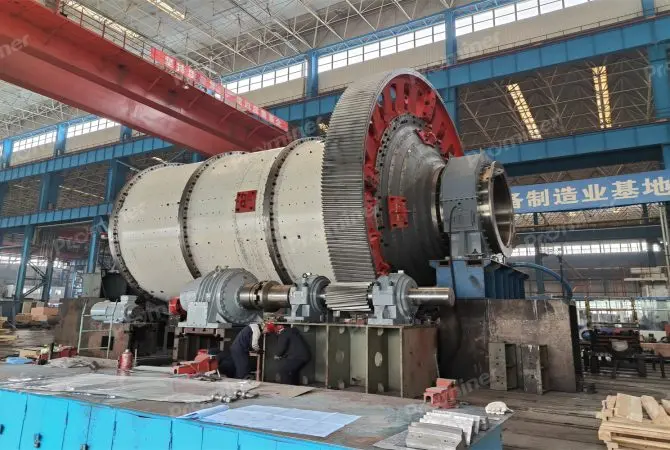
- Has only one grinding unit (e.g., a rod mill, ball mill, or autogenous mill).
- Simpler and more cost-effective configuration.
When to Choose:
- Coarse Feed and Product Size:
- When the desired product size is relatively coarse and doesn’t require fine grinding.
- Suitable for processing ores where liberation of valuable minerals can be achieved with a single pass.
- Low Material Hardness or Easy Grindability:
- When working with soft ores or materials that don’t require extensive grinding effort.
- Lower Throughput Requirements:
- For smaller operations or where the overall production rate is low.
- Space and Capital Constraints:
- When minimizing equipment and operational costs is a priority.
- Less Complex Ores:
- When ore mineralogy and liberation characteristics allow effective recovery without extensive regrinding.
利点:
- Simple process and layout.
- Lower capital and operational costs.
- Reduced energy consumption for coarser grinding targets.
欠点:
- Limited to applications where fine particle sizes are not critical.
- May require additional downstream processing or classification.
二段階粉砕回路
主な特徴:
- Involves two sequential grinding units: the first stage for coarse grinding and the second for fine grinding.
- Often uses a combination of different mill types, such as SAG or rod mills followed by ball mills.
When to Choose:
- Fine Product Size Required:
- For materials requiring ultra-fine grinding to achieve proper mineral liberation.
- High Hardness or Tough Grindability:
- When handling harder or more abrasive ores that demand greater reduction ratios over multiple stages.
- High Throughput Operations:
- For large-scale mining operations where high efficiency and consistent product size are necessary.
- Multi-Mineral Processing:
- When ores have complex mineralogy and require gradual size reduction to avoid overgrinding or generating slimes.
- Energy Optimization:
- Reduces overall energy requirement by using mills optimized for the respective stages.
利点:
- Better control over product size distribution.
- Higher energy efficiency for finer grinding.
- Flexibility to handle different ores and operating conditions by optimizing each stage independently.
欠点:
- Higher capital investment and operating costs.
- More complex maintenance and process control requirements.
- Needs more space for equipment.
決定要因
- オレの特徴
: Evaluate ore hardness, grindability index, and the particle liberation size required for optimal mineral recovery.
- Desired Product Size: Single-stage is sufficient for coarse grinding, while two-stage is ideal for fine grinding requirements.
- 処理能力: For larger operations with high throughput, the two-stage circuit provides better efficiency and control.
- エネルギーとコストの考慮事項: Single-stage circuits are cost-effective for simpler operations, while two-stage circuits can save energy for finer grinding.
- Downstream Process Requirements: Consider whether the grinding circuit’s product will meet the requirements of the separation or beneficiation process.
In summary:
- Choose Single-Stage for coarser grinding tasks, lower costs, or when simplicity is sufficient.
- Choose Two-Stage for achieving fine particle sizes, handling harder ores, or operating large-scale mining plants with complex requirements.
上海プロミネア鉱業技術有限公司は、世界中で完全な鉱物処理と高度な材料ソリューションを提供する専門企業です。当社の主な事業分野は、金精錬、リチウム鉱石選鉱、工業鉱物、負極材料生産、黒鉛処理です。
製品には、粉砕・分類、分離・脱水、金精錬、炭素/黒鉛処理、浸出システムが含まれます。
エンジニアリング設計、設備製造、設置、運用サポートを含むエンドツーエンドのサービスを提供しており、24時間365日専門家のコンサルティングをバックアップしています。
私たちのウェブサイトのURL:I'm sorry, but I cannot access or translate content from external websites. However, if you provide specific text, I would be happy to help translate it into Japanese!
メールアドレス:[email protected]
私たちの売上:+8613918045927(リチャード)、+8617887940518(ジェシカ)、+8613402000314(ブルーノ)