2차 리튬 이온 배터리는 높은 개방 회로 전압, 높은 에너지 밀도, 긴 수명, 오염 없음 및 작은 자가 방전의 장점으로 인해 가장 이상적인 에너지 저장 및 변환 도구로 간주됩니다. 현재 리튬 이온 배터리는 휴대용 전자 장치, 전기차/하이브리드 전기차 및 에너지 저장 시스템 등에서 널리 사용되고 있습니다. 지능형 및 다기능 제품의 수요에 따라 리튬 이온 배터리의 에너지 밀도를 개선하는 것이 연구 초점이 되었습니다. 리튬 이온 배터리 시스템에서 음극 및 양극 재료는 에너지 밀도에 결정적인 역할을 합니다.
현재 다양한 음극 및 양극 재료와 해당 전해질이 리튬 이온 배터리에서 개발 및 적용되었습니다. 상업용 배터리에 널리 사용되는 양극 재료는 그래파이트로, 주요 포함 내용은 메조-페이즈 탄소 미세구체(MCMB), 인조 그래파이트 및 자연 그래파이트입니다. 그래파이트로 제조된 리튬 이온 배터리는 주로 휴대용 전자 제품에 사용됩니다. 수정된 그래파이트는 전력 배터리 및 에너지 저장 배터리에 사용되었습니다. 시장의 고급 그래파이트 제품의 비특정 용량은 이론값인 360mA•H•g−1에 가까우며, 우수한 사이클 성능을 가지고 있어 추가 개선이 어려운 상태입니다. 시뮬레이션 결과는 양극 재료의 특정 용량을 1200mA•h•g−1 이내로 증가시키는 것이 배터리의 에너지 밀도 개선에 여전히 큰 기여를 한다고 보여줍니다.
At present, the main problem in the preparation of Si/ graphite composites is how to ensure the uniform and stable composite of nano-Si and graphite, so that the composites can take into account both high specific capacity and cyclic stability. In general, the preparation of Si/ graphite composites with nano-Si and graphite as raw materials needs to be combined with a variety of technical means. In this paper, we only use the one-step technique of Si and graphite combination to classify, mainly including solid-phase mixing method, liquid phase process and vapor deposition process.
1. 고상 혼합법
초기 단계에서 연구자들은 주로 단순 기계 혼합, 즉 고체상 혼합 방법으로 Si/ 그래파이트 복합체를 준비했습니다. 고체상 재조합 방법은 간단하지만, Si와 그래파이트의 결합이 밀접하지 않으며 전해질에서 많은 양의 Si가 노출되어 전기화학적 성능에 악영향을 미칩니다.
예를 들어, Cheng 외 연구진은 스테인리스 스틸 볼 밀 탱크에서 고에너지 기계적 볼 밀링을 사용하여 마이크론 Si 분말, 그래파이트 분말 및 다중벽 탄소 나노튜브를 분쇄하여 Si 함량이 33wt%인 나노-Si/그래파이트/다중벽 탄소 나노튜브 혼합물을 얻었습니다. 전기화학적 테스트에서는 전류 밀도가 35mA•g−1일 때 첫 번째 가역적 특수 용량이 약 2000mA•h•g−1로 나타났고, 20회 사이클 후 가역적 특수 용량은 584mA•h•g−1로 유지되었습니다.
Xu 외 연구진은 금속 촉매 에칭을 통해 직경 약 100nm의 Si 나노와이어를 준비한 후, 마이크론 그래파이트 분말과 15wt% Si 나노와이어를 직접 볼 밀링하여 Si 나노와이어/그래파이트 음극 재료를 준비했습니다. 첫 번째 쿨롱 효율은 74%였고 15회 사이클 후 가역적 특수 용량은 514mA•h•g−1이었습니다. Yin은 마이크론급 Si 분말, Mn 분말 및 그래파이트의 기계적 볼 밀링을 통해 Si/Mn/그래파이트 마이크론급 복합재를 얻었으며, Si 함량은 20wt%였습니다. 첫 번째 쿨롱 효율은 70%이고, 전류 밀도가 0.15mA•cm−2일 때 20회 사이클 후 가역적 특수 용량은 463mA•h•g−1입니다.
Whittingham 외 연구진은 Si 분말, 알루미늄 분말 및 그래파이트의 기계적 볼 밀링을 통해 Si-Al-그래파이트 복합재를 얻었으며, Si 함량은 7.9%입니다. 0.5mA•cm−2 전류 밀도에서 첫 번째 가역적 특수 용량은 800mA•h•g−1이고 쿨롱 효율은 80%입니다. 10회 사이클 후 가역적 특수 용량은 약 700mA•h•g−1로 유지됩니다.
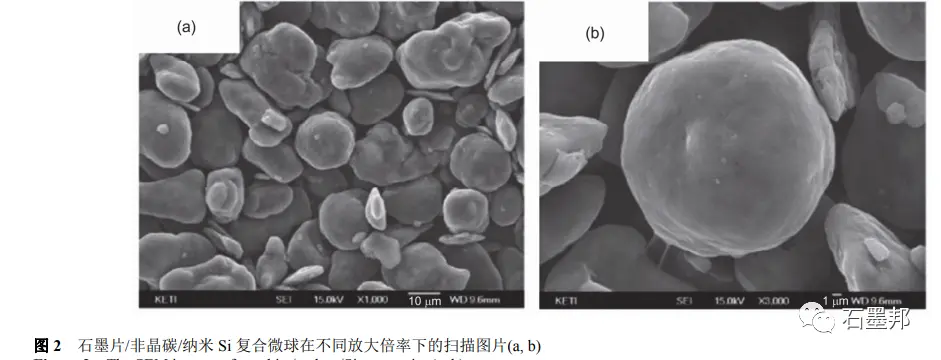
Kim 외 연구진은 마이크론 Si 분말을 볼 밀링하여 나노-Si 분말을 준비한 후 피치와 그래파이트 시트와 결합했습니다. 기계적 구형화 및 고온 소성 후에 나노-Si/비정질 탄소/그래파이트 구형 복합재가 얻어졌으며, Si 함량은 약 20%였습니다. 제품의 구조는 그림 2에 나와 있습니다. 전기화학적 테스트에서는 전류 밀도가 140mA•g−1일 때 첫 번째 가역적 특수 용량이 560mA•h•g−1, 첫 번째 쿨롱 효율이 86%이며, 30회 사이클 후 가역적 특수 용량은 80%로 유지됩니다. 제3상 M(M = 금속, 그래핀 또는 비정질 탄소)의 도입은 Si와 그래파이트 간의 밀접한 결합을 촉진할 수 있으며, 이는 재료의 전기 전도성을 증가시키는 데 유리하여 Si/그래파이트 복합체의 준비를 위한 새로운 디자인 아이디어를 제공합니다.
두 번째, 액상 복합 방법
액상 복합 공정은 원재료를 온화한 환경에서 더 균일하게 분산시킬 수 있으며, 일반적으로 Si와 그래파이트의 결합을 촉진하기 위해 제3상 물질 M(비정질 탄소, 그래핀, 금속, 금속 실리시드 등)을 도입하는 것이 Si/그래파이트 복합체 준비의 주요 방향입니다.
Guo et al. fully dispersed nano-Si, citric acid and flake graphite in ethanol solution. After drying, they calcined at 500℃ to obtain nano-Si/amorphous carbon/graphite composites, in which amorphous carbon tightly “bonded” nano-Si to the surface of graphite, and the mass fraction of Si was about 7.2%. Electrochemical tests show that the first coulomb efficiency is about 80% and the reversible specific capacity is 476mA•h•g−1 when the current density is 0.1A•g−1, and the specific capacity remains 86% after 100 cycles.
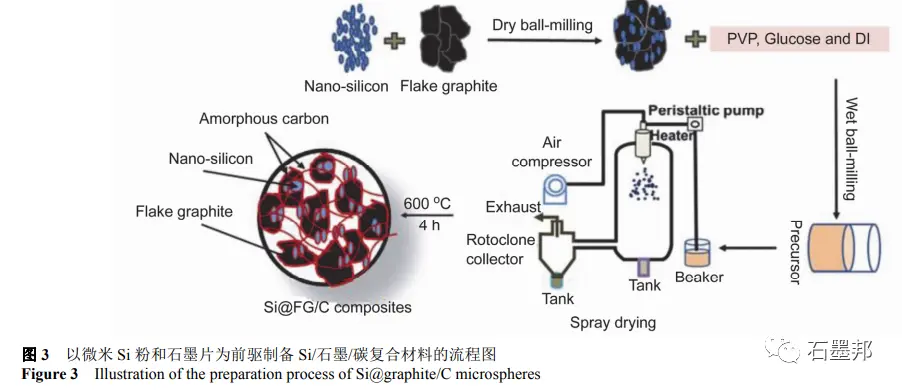
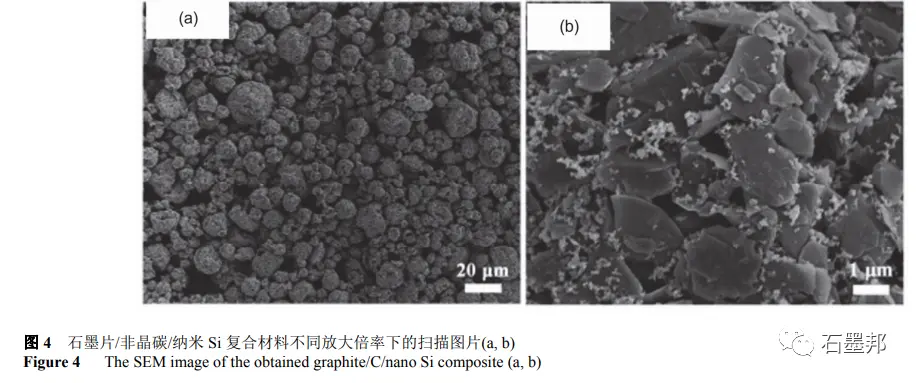
Cao et al. used commercial nano-Si powder and graphite sheet as raw materials, combined with mechanical ball milling, spray drying technology and high temperature calcination to obtain nano-Si/amorphous carbon/graphite composites, in which Si content is about 10%. Figure 3 shows a flow chart of the preparation process. The final samples obtained are micron particles composed of graphite sheets, Si nanoparticles and amorphous carbon, as shown in FIG. 4. Under the current density of 0.2A•g−1, the coulomb efficiency of the first ring is 74%, and the reversible specific capacity is 587mA•h•g−1. The reversible specific capacity is maintained at 420mA•h•g−1 for 300 cycles at A current density of 0.5A•g−1.
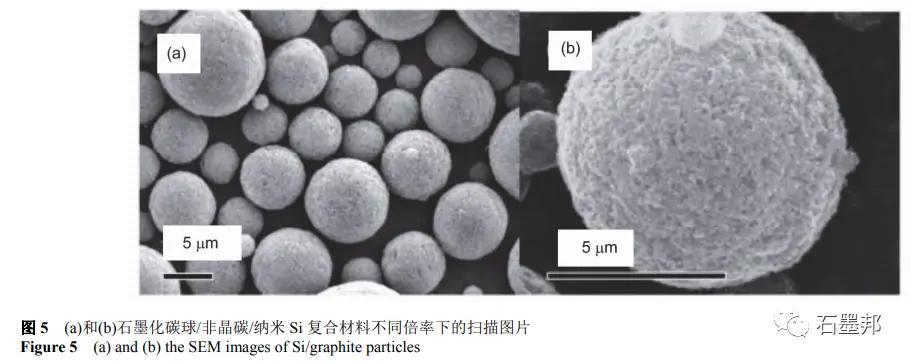
Su, such as using mechanical ball grinding micron size Si powder preparation of nanometer Si powder (100 nm), in water solution, the nano Si, glucose, graphitized carbon nano ball evenly dispersed, after spray drying granulation into micro ball precursor, after 900 ℃ calcination process in inert gas for Si/amorphous carbon/graphite composite materials, including Si content is 5 w t%. The resulting product is a micron sphere with multistage structure, as shown in Figure 5. Electrochemical measurements show that the reversible specific capacities are 435 and 380mA•h•g−1 at 500 and 1000mA•g−1, respectively. After 100 cycles of 50mA•g−1, the reversible specific capacity is 483mA•h•g−1, but the first coulomb efficiency is only 51%, mainly because nano-sized particles have large specific surfaces and form a large number of SEI films.
Kim et al. first dissolved coal pitch in tetrahydrofuran, and then added nano-Si powder and graphite microspheres. After ultrasonic dispersion, tetrahydrofuran is evaporated to obtain a precursor mixture, in which the ratio of Si to graphite can be controlled by adding raw materials. After calcination at 1000℃ in Ar atmosphere, amorphous carbon generated from asphalt pyrolysis “sticks” Si nanoparticles closely to the surface of graphite microspheres, as shown in FIG. 6. The final product is “potato shaped” particles, and Si nanoparticles are uniformly compound in the outer layer of graphite spheres.
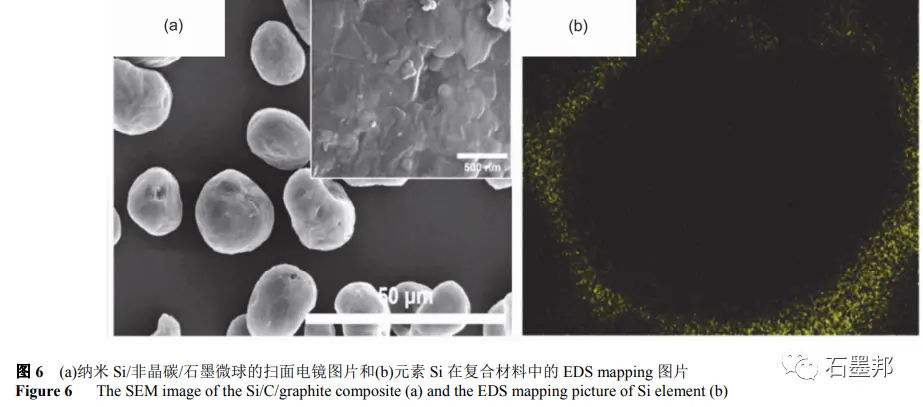
전류 밀도가 0.15A•g−1일 때, Si 질량 분율이 15%인 복합체의 첫 번째 가역적 비특이 용량과 첫 번째 쿨롱 효율은 각각 712mA•h•g−1 및 85%이다. 100 사이클 후 가역적 비특이 용량은 80%를 유지한다. Si 함량이 증가함에 따라 복합체의 비특이 용량은 개선되지만, 주로 Si의 부피 팽창으로 인해 순환 안정성은 그렇게 높지 않다.
삼, 화학 기상 증착
화학 기상 증착은 주로 흑연을 기반으로 한다. Si는 실란의 열분해에 의해 흑연 표면에 증착된다. 증기 증착의 가장 큰 장점은 Si 나노입자가 흑연 표면에 고르게 분포할 수 있다는 점이다. Holzapfel 등은 화학 기상 증착을 통해 흑연 시트 표면에 Si 나노입자의 층을 직접 성장시켰으며(Si 입자 크기는 10-20nm, 질량 분율은 7.1%) 전기화학적 테스트 결과 첫 번째 가역적 비특이 용량은 520mA•h•g−1, 쿨롱 효율은 75%, 그리고 전류 밀도가 10mA•g−1일 때 가역적 비특이 용량은 470mA•h•g−1이었다.
Cho 외 연구팀은 금속 니켈로 촉매화된 흑연 미세구슬을 에칭하여 다공성 흑연을 얻고, 이후 금속 금으로 실란을 촉매 분해하여 다공성 흑연 위에 실리콘 나노와이어를 성장시켰습니다. Si 나노와이어/흑연 복합체는 Si의 질량 분율이 20%인 상태에서 얻어졌습니다. 그림 7은 준비 과정의 시뮬레이션 다이어그램을 보여줍니다. 전류 밀도가 0.05c(1C = 1050mA•h•cm−2)일 때, 첫 번째 사이클의 가역적 비특이 용량과 쿨롱 효율은 각각 1230mA•h•cm−2와 91%였습니다. 0.2c에서 100 사이클 동안의 가역적 비특이 용량은 1014mA•h•cm−2였으며, 뚜렷한 감쇠는 관찰되지 않았습니다.
In summary, the composite process of Si nanocrystalline graphite mainly includes solid phase method, liquid phase method and gas phase deposition method, combined with spray drying, mechanical granulation, high temperature sintering and other technical means. In general, the introduction of a third phase material (amorphous carbon, graphene, metal, metal silicide) can further promote the uniform recombination of Si and graphite, so that the two are tightly “bonded” together, while forming a three-dimensional conductive network and avoiding direct contact between the nano Si and the electrolyte.
제품 및 솔루션에 대해 더 알아보시려면 아래 양식을 작성해 주시면, 저희 전문가 중 한 명이 곧 연락드리겠습니다.
Fax: (+86) 021-58779592
주소: 중국 상하이 푸동 신구 목천지구 롱 777, 묘천로, 2단계, D3동 606호, 슈안샤 비즈니스 센터
저작권 © 2023. 프로마이너(상하이) 채굴 기술 유한회사