

/
/
Méthode d'identification du graphite naturel et du graphite artificiel

Le matériau d'anode en graphite naturel est fabriqué à partir de graphite cristallin en flocons naturels, qui est traité par broyage, sphéroïdisation, classification, purification et surface, etc. Sa haute cristallinité se forme naturellement. Et le matériau d'anode en graphite artificiel est un carbone facile à graphitiser tel que la coque de pétrole, la coque d'aiguille, la coque d'asphalte, calciné à une certaine température, puis après concassage, classement, système de graphitisation à haute température, sa haute cristallinité est formée par graphitisation à haute température. C'est à cause de la différence essentielle dans les matières premières et la technologie de préparation que la microstructure, la structure cristalline, les performances électrochimiques et les performances de traitement des deux sont évidemment différentes.
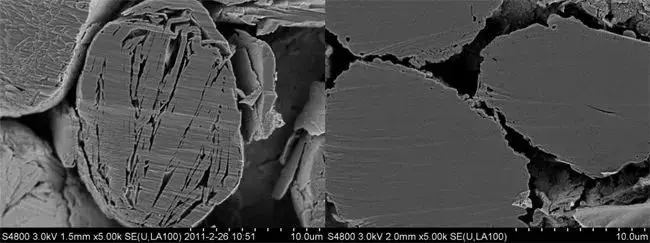
En termes de microstructure, le graphite naturel est stratifié. Le profil SEM du graphite naturel conserve la structure lamellaire, et il y a beaucoup d'espaces entre les structures lamellaires. Dans le processus de graphitisation à haute température, la structure cristalline est réarrangée selon la structure ABAB, et la contraction par polymérisation, et sa densité interne, sans espace.
Diffraction des rayons X
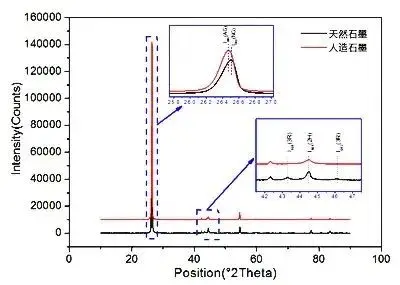
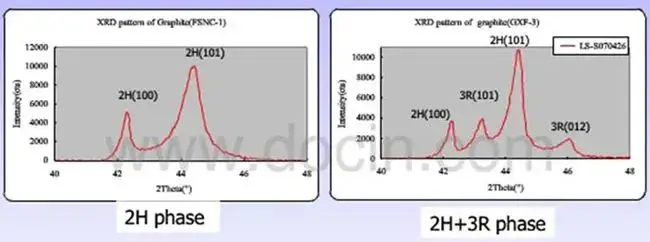
From the perspective of crystal structure, the natural graphite anode material has high crystallinity. In the XRD pattern, its (002) crystal plane diffraction peak Angle is higher, the lamellar structure is complete, the layer spacing is small, and the orientation (I002/I110) is obvious. From the diffraction peak position of (101) crystal plane corresponding to 43-45 degree and the diffraction peak position of (012) crystal plane corresponding to 46-47 degree, It can be seen that natural graphite has obvious 2H phase and 3R phase, while artificial graphite only has 2H phase. The XRD patterns of hexagonal graphite (2H) and rhombohedral graphite (3R) are as follows:
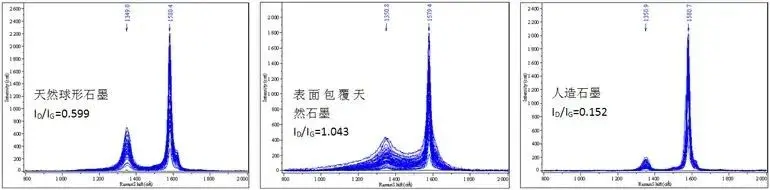
For natural graphite and artificial graphite without graphitization treatment, in addition to the SEM profile, XRD crystal structure diagram and its parameters to distinguish, Raman spectrum test disorder ID/IG is also an effective method to distinguish these two types of graphite. The disorder degree ID/IG of natural spherical graphite is generally 0.4~0.85, the disorder degree ID/IG of natural graphite coated on the surface without graphitization is generally 0.9~1.6, and the disorder degree ID/IG of new modified natural graphite without graphitization is generally 0.2~0.6. The disorder degree OF artificial graphite ID/IG is generally 0.04~0.34. On the whole, the disorder degree ID/IG of natural graphite anode material without high temperature graphitization is larger than that of artificial graphite anode material. The disorder degree ID/IG of the graphitized natural graphite coated on the surface is generally 0.17~0.36, and that of the artificial graphite is generally 0.04~0.34. The disorder degree ID/IG of the graphitized natural graphite and the artificial graphite are in intersection, and Raman test is not an effective method.
(1) Coupe SEM : La coupe SEM du matériau d'anode en graphite naturel sans graphitisation à haute température présente des espaces entre les structures en flocons, tandis que la coupe SEM du matériau d'anode en graphite artificiel est dense et sans couture.
(2) XRD : Il y a des phases 2H et 3R évidentes dans le motif XRD du matériau d'anode en graphite naturel sans traitement de graphitisation à haute température, et seule la phase 2H existe dans le motif XRD du matériau d'anode en graphite artificiel.
(3) ID/IG : Le désordre ID/IG du matériau d'anode en graphite naturel recouvert à la surface sans graphitisation à haute température est généralement de 0,9 à 1,6, et le désordre ID/IG du graphite artificiel est généralement de 0,04 à 0,34.
(1) Coupe SEM : La coupe SEM du matériau d'anode en graphite naturel pur traité par graphitisation à haute température présente des espaces entre les structures en flocons, tandis que la coupe SEM du matériau d'anode en graphite artificiel pur a une structure dense et sans espaces, et a été soumise à une graphitisation à haute température. La vue de coupe SEM du matériau d'anode en graphite composite montre que les vides entre les structures en flocons de graphite naturel et la structure dense et sans couture du graphite artificiel coexistent.
Pour en savoir plus sur nos produits et solutions, veuillez remplir le formulaire ci-dessous et l'un de nos experts vous répondra sous peu
Projet de flottation de l'or de 3000 TPD dans la province du Shandong
Flottation de minerai de lithium de 2500 TPD au Sichuan
Fax: (+86) 021-58779592
Adresse : Chambre 606, Bâtiment D3, Phase II, Centre d'affaires de Chuansha, 777 Long, Route Miaochuan, Zone de Pudong, Shanghai, Chine
Droits d'auteur © 2023. Prominer (Shanghai) Mining Technology Co., Ltd.


