


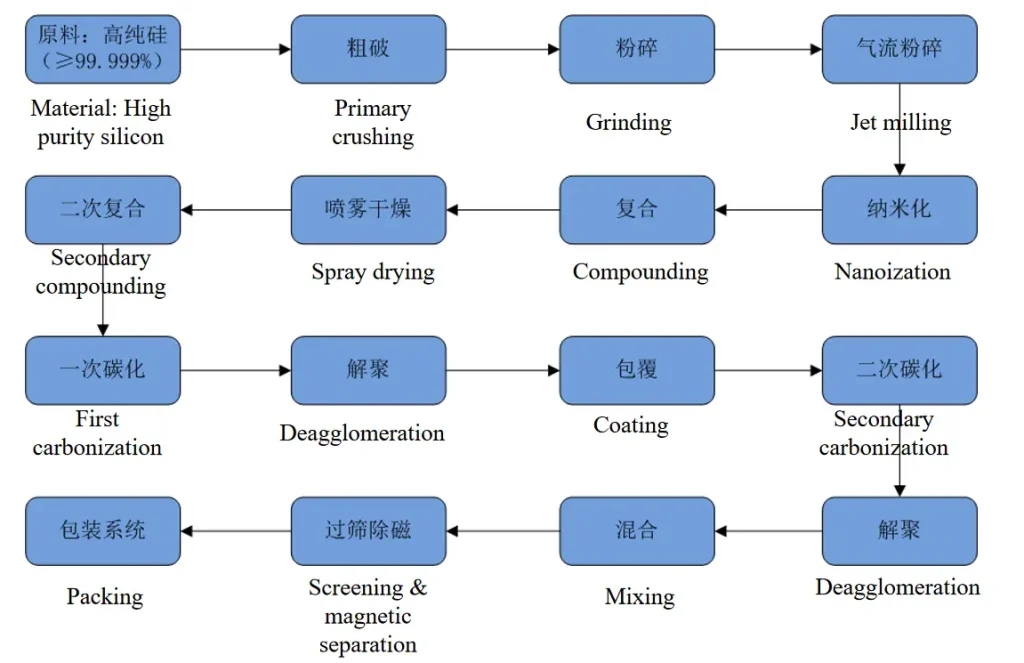
二次リチウムイオンバッテリーは、高いオープン回路電圧、高エネルギー密度、長寿命、公害なし、自己放電が少ないという利点から、最も理想的なエネルギー貯蔵および変換ツールと考えられています。現在、リチウムイオンバッテリーは、ポータブル電子機器、電気自動車/ハイブリッド電気自動車、エネルギー貯蔵システムなどに広く使用されています。インテリジェントで多機能な製品の需要に伴い、リチウムイオンバッテリーのエネルギー密度を改善することが研究の焦点となっています。リチウムイオンバッテリーシステムにおいて、陽極および陰極材料は、そのエネルギー密度に決定的な役割を果たします。
現在、さまざまな陽極および陰極材料、及び対応する電解質がリチウムイオンバッテリーに開発され、適用されています。商業バッテリーで広く使用されている陰極材料はグラファイトであり、主にメソフェーズカーボンマイクロスフェア(MCMB)、人工グラファイト、天然グラファイトが含まれます。グラファイト製のリチウムイオンバッテリーは主にポータブル電子製品に使用されています。改良グラファイトは、動力バッテリーやエネルギー貯蔵バッテリーに使用されています。市場に出回っている高級グラファイト製品の比容量は理論値の360mA•h•g−1に近く、優れたサイクリング性能を有しており、さらなる改善が難しいことが分かっています。シミュレーション結果は、陰極材料の比容量を1200mA•h•g−1以内で増加させることがバッテリーのエネルギー密度を改善する大きな貢献になることを示しています。
At present, the main problem in the preparation of Si/ graphite composites is how to ensure the uniform and stable composite of nano-Si and graphite, so that the composites can take into account both high specific capacity and cyclic stability. In general, the preparation of Si/ graphite composites with nano-Si and graphite as raw materials needs to be combined with a variety of technical means. In this paper, we only use the one-step technique of Si and graphite combination to classify, mainly including solid-phase mixing method, liquid phase process and vapor deposition process.
一、固相混合法
初期段階では、研究者たちは主にシンプルな機械的混合、すなわち固相混合法によってSi/グラファイト複合体を準備していました。固相再結合法は簡単ですが、Siとグラファイトの結合が緊密ではなく、大量のSiが電解質にさらされているため、電気化学的性能に悪影響を及ぼします。
例えば、Cheng et al.は高エネルギー機械式ボールミルを使用して、ステンレス鋼のボールミルタンク内でマイクロンSi粉末、グラファイト粉末、及び多層カーボンナノチューブを粉砕し、Si含量が33wt%のナノSi/グラファイト/多層カーボンナノチューブの混合物を得ました。電気化学的試験では、電流密度が35mA•g−1のとき、初回の可逆的比容量は約2000mA•h•g−1であり、20サイクル後の可逆的比容量は584mA•h•g−1に維持されました。
Xuらは、金属触媒エッチングによって直径約100nmのSiナノワイヤを製造し、次に15wt%のSiナノワイヤとマイクログラファイト粉末を直接ボールミルで混合してSiナノワイヤ/グラファイトアノード材料を準備しました。最初のコロンブ効率は74%で、15サイクル後の可逆容量は514mA・h・g−1です。Yinは、マイクログレードのSi粉末、Mn粉末、グラファイトを機械的ボールミルで混合することによってSi/Mn/グラファイトのマイクログレード複合材料を得ました。このとき、Siの含有率は20wt%です。最初のコロンブ効率は70%で、電流密度が0.15mA・cm−2のとき、20サイクル後の可逆容量は463mA・h・g−1です。
ウィッティンガムらは、Si粉末、アルミニウム粉末およびグラファイトを機械的ボールミルで粉砕することで、7.9%のSi含有量のSi-Al-グラファイト複合材料を得ました。電流密度0.5mA•cm−2において、最初の可逆的比容量は800mA•h•g−1で、コロンブ効率は80%です。10サイクル後、可逆的比容量は約700mA•h•g−1に維持されます。
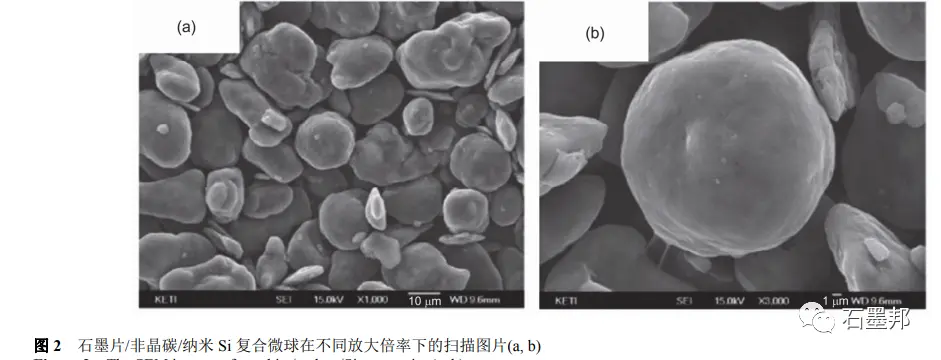
キムらは、ミクロンサイズのSi粉末をボールミルで粉砕し、ピッチおよびグラファイトシートと複合させてナノSi粉末を準備しました。機械的顆粒化と高温カルシネーションの後、ナノSi/非晶質炭素/グラファイト球状複合材料を得て、Si含有量は約20%でした。製品の構造は図2に示されています。電気化学的試験では、電流密度140mA•g−1において最初の可逆的比容量が560mA•h•g−1、最初のコロンブ効率が86%であり、可逆的比容量は30サイクル後も80%を維持しました。第三の相M(M = 金属、グラフェンまたは非晶質炭素)の導入は、Siとグラファイトの密接な結合を促進し、材料の導電性を向上させるのに寄与し、Si/グラファイト複合材料の準備に新たな設計アイデアを提供します。
二、液相複合法
液相複合プロセスは、生原料を穏やかな環境でより均等に分散させることができ、通常は第三の相物質M(非晶質炭素、グラフェン、金属、金属シリサイドなど)を導入してSiとグラファイトの結合を促進します。これはSi/グラファイト複合材料の準備の主要な方向性です。
Guo et al. fully dispersed nano-Si, citric acid and flake graphite in ethanol solution. After drying, they calcined at 500℃ to obtain nano-Si/amorphous carbon/graphite composites, in which amorphous carbon tightly “bonded” nano-Si to the surface of graphite, and the mass fraction of Si was about 7.2%. Electrochemical tests show that the first coulomb efficiency is about 80% and the reversible specific capacity is 476mA•h•g−1 when the current density is 0.1A•g−1, and the specific capacity remains 86% after 100 cycles.
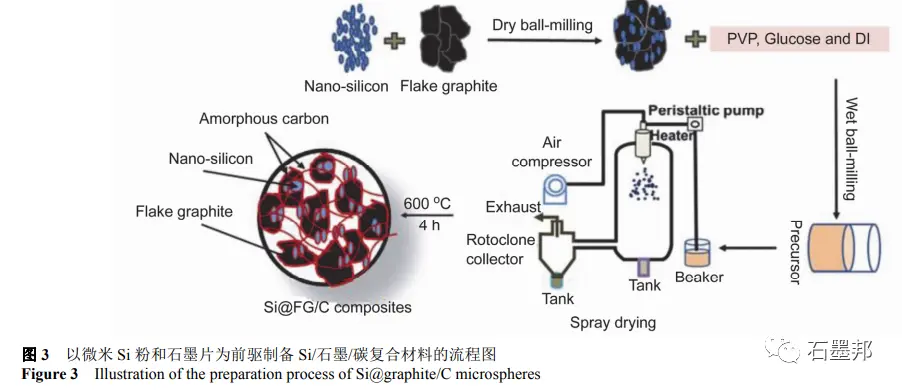
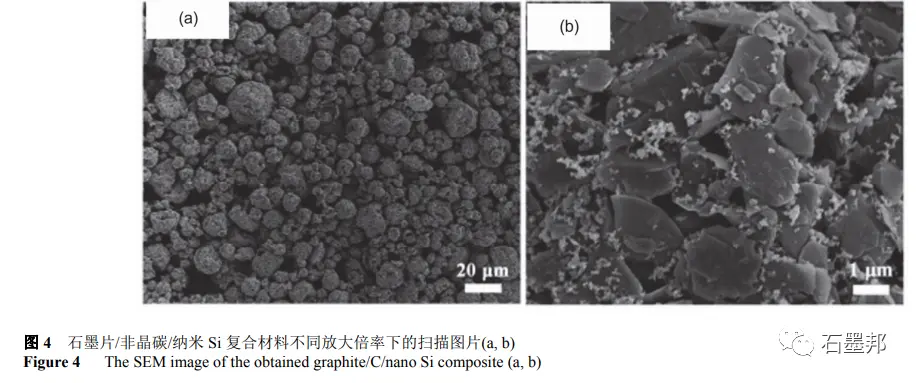
Cao et al. used commercial nano-Si powder and graphite sheet as raw materials, combined with mechanical ball milling, spray drying technology and high temperature calcination to obtain nano-Si/amorphous carbon/graphite composites, in which Si content is about 10%. Figure 3 shows a flow chart of the preparation process. The final samples obtained are micron particles composed of graphite sheets, Si nanoparticles and amorphous carbon, as shown in FIG. 4. Under the current density of 0.2A•g−1, the coulomb efficiency of the first ring is 74%, and the reversible specific capacity is 587mA•h•g−1. The reversible specific capacity is maintained at 420mA•h•g−1 for 300 cycles at A current density of 0.5A•g−1.
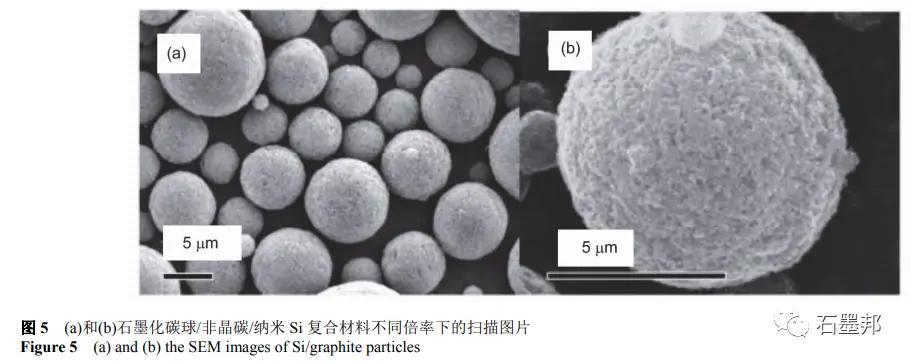
Su, such as using mechanical ball grinding micron size Si powder preparation of nanometer Si powder (100 nm), in water solution, the nano Si, glucose, graphitized carbon nano ball evenly dispersed, after spray drying granulation into micro ball precursor, after 900 ℃ calcination process in inert gas for Si/amorphous carbon/graphite composite materials, including Si content is 5 w t%. The resulting product is a micron sphere with multistage structure, as shown in Figure 5. Electrochemical measurements show that the reversible specific capacities are 435 and 380mA•h•g−1 at 500 and 1000mA•g−1, respectively. After 100 cycles of 50mA•g−1, the reversible specific capacity is 483mA•h•g−1, but the first coulomb efficiency is only 51%, mainly because nano-sized particles have large specific surfaces and form a large number of SEI films.
Kim et al. first dissolved coal pitch in tetrahydrofuran, and then added nano-Si powder and graphite microspheres. After ultrasonic dispersion, tetrahydrofuran is evaporated to obtain a precursor mixture, in which the ratio of Si to graphite can be controlled by adding raw materials. After calcination at 1000℃ in Ar atmosphere, amorphous carbon generated from asphalt pyrolysis “sticks” Si nanoparticles closely to the surface of graphite microspheres, as shown in FIG. 6. The final product is “potato shaped” particles, and Si nanoparticles are uniformly compound in the outer layer of graphite spheres.
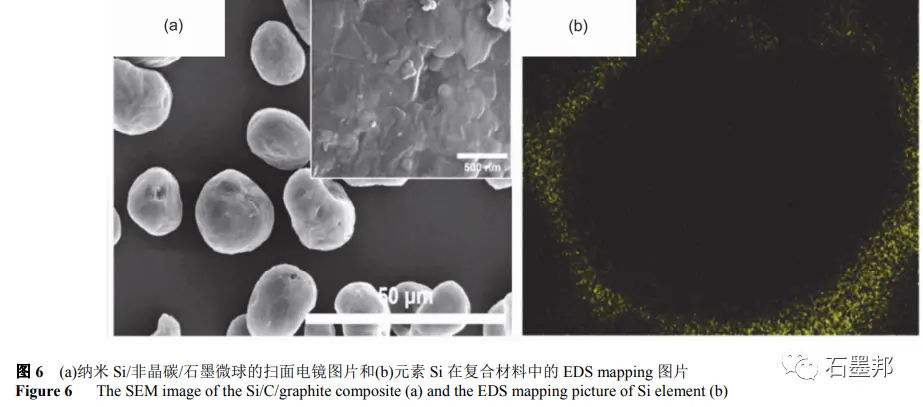
電流密度が0.15A•g−1のとき、シリコン質量分率15%の複合材料の最初の可逆的比容量は712mA•h•g−1、最初のクーロン効率は85%です。100サイクル後、可逆的比容量は80%のままです。シリコン含量が増すにつれて、複合材料の比容量は向上しますが、サイクリック安定性はそれほど高くなく、主にシリコンの体積膨張によるものです。
三、化学気相成長
化学気相成長は主にグラファイトに基づいています。シリルの熱分解によって、グラファイト表面にシリコンが堆積します。気相堆積の最大の利点は、シリコンナノ粒子がグラファイト表面に均等に分布できることです。ホルツァッペルらは、化学気相成長によりグラファイトシートの表面にシリコンナノ粒子の層を直接成長させました(シリコン粒子サイズは10-20nm、質量分率は7.1%)。電気化学テストの結果、最初の可逆的比容量は520mA•h•g−1、クーロン効率は75%、電流密度が10mA•g−1のとき可逆的比容量は470mA•h•g−1でした。
チョらは、金属ニッケルによって触媒されるグラファイトマイクロスフェアをエッチングして多孔性グラファイトを得た後、金属金のシリルの触媒クラックにより多孔性グラファイト上にシリコンナノワイヤを成長させました。シリコン質量分率は20%のシリコンナノワイヤ/グラファイト複合材料が得られました。図7は準備プロセスのシミュレーション図を示しています。電流密度が0.05c(1C = 1050mA•h•cm−2)のとき、最初のサイクルの可逆的比容量とクーロン効率はそれぞれ1230mA•h•cm−2および91%でした。0.2cで100サイクルの可逆的比容量は1014mA•h•cm−2であり、明らかな減衰は観察されませんでした。
In summary, the composite process of Si nanocrystalline graphite mainly includes solid phase method, liquid phase method and gas phase deposition method, combined with spray drying, mechanical granulation, high temperature sintering and other technical means. In general, the introduction of a third phase material (amorphous carbon, graphene, metal, metal silicide) can further promote the uniform recombination of Si and graphite, so that the two are tightly “bonded” together, while forming a three-dimensional conductive network and avoiding direct contact between the nano Si and the electrolyte.
私たちの製品とソリューションについて詳しく知るためには、以下のフォームに記入してください。私たちの専門家の一人がすぐにご連絡いたします
Fax: (+86) 021-58779592
住所: 中国上海浦东新区苗川路777号川沙商务中心D3楼606室第二期
著作権 © 2023. プロマイナー(上海)鉱業技術有限公司


